Agentic AI: A Practical Approach to AI Transformation in Large Enterprises
Is your organization ready to delegate mission-critical tasks to a workforce that has no voice, no paycheck, and no need for a coffee break?
Are your teams blocked by technology limitations—or by leadership’s hesitation to let AI take action?
What would your organization look like if you let AI handle 40% of operational decisions—starting today?
Today, companies are investing heavily in AI tools, automation platforms, and digital roadmaps. Yet most of them still work the same way they did 10 years ago, humans push every task forward, decisions move slowly, and teams fear experimenting with AI beyond simple prompts.
“The future of work won’t be unlocked by tools, but by leaders who change the way work is allowed to happen.”
Most organizations have only experienced Passive AI—systems that wait for a command. You ask a chatbot a question, generate a report, request a summary, and it responds. It’s helpful, but still dependent on human intervention.
Agentic AI is a different world.
Agentic AI systems are not just large language models (LLMs), they are systems with the ability:
- To take autonomous actions, they not just give answers
- Manage workflows end-to-end
- Make low-risk decisions on human’s behalf
- Monitor performance continuously
- Suggest improvements and implement them also
- Collaborate with other agents to execute tasks
Agentic AI is not a tool. It is a co-worker.
This transition needs to be understood for the cultural foundations of the business. It must change before the agents are deployed at scale. It demands a new culture.
Organizations don’t transform because employees start using AI. They transform because leaders give permission to transform. Upskilling of the workforce is required to transform them into AI-enabled workforce.
Before teams can adopt Agentic AI, leaders must demonstrate:
- Trust in autonomous decision-making
- Openness to experimentation
- Psychological safety for teams to try and fail
- A willingness to delegate to AI, not just people (can start with small and low-risk tasks)
If leaders still measure success by hours spent, tasks manually done, or control held tightly, Agentic AI will never thrive.
Cultural transformation cascades from:
Leadership → Teams → Workflows → Business outcomes.
The successful adoption of Agentic AI is not an IT initiative—it is a leadership mandate.
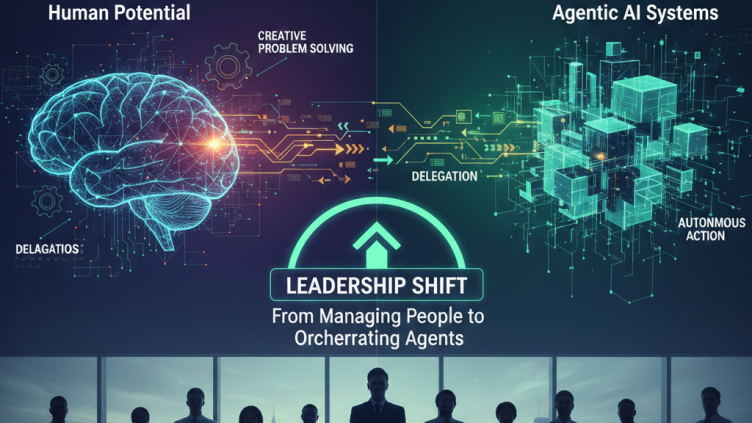
In the age of Agentic AI, leadership is no longer about supervising people—it’s about empowering systems.
Without a shift in leadership mindset - from managing people to orchestrating agents—the technology will fail to deliver its potential. Only leadership can dismantle the walls of resistance by actively demonstrating a new path.
Leaders must ask:
How can AI extend the capability of my teams?
Where can agents accelerate execution?
How do I measure success when work is partly autonomous?
Leadership evolves from “being the smartest person in the room” to being the enabler of intelligence—human and machine.
Agentic AI introduces real fears:
- Employees fear replacement
- Managers fear loss of control
- Teams fear mistakes
- Organizations fear unknown risks
Leaders must address the cultural challenge with clarity, training, and transparency, not silence.
They must establish a protocol that differentiates between Agent-Caused Failure (a bug, a data error) and Human-Caused Error (a poorly defined goal, inadequate oversight). Psychological safety is non-negotiable. Employees must feel safe reporting agent failures without fearing blame—or automation replacing them.
Agentic AI isn’t about replacing people, it is about upgrading them.
Employees must be repositioned as:
- Supervisors
- Strategists
- Ethical governors
- Orchestrators of intelligent systems
By delegating tactical and repetitive work to agents, humans can focus on creativity, strategy, judgment, and innovation. This requires mandating training in new skills for Agent Orchestration—the ability to communicate complex, multi-step goals to autonomous systems, interpreting AI-driven actions. Leaders must invest in it aggressively.
The shift to Agentic AI offers an inspiring vision: an organization where human potential is truly maximized. By delegating the repetitive, linear tasks to agents, we free our workforce to focus on innovation, deep strategy, and the uniquely human aspects of collaboration.
The organizations that will lead the next decade are not the ones with the most data or the most advanced tools. They will be the ones with leaders who boldly declare:
“We are ready to let AI work with us, not just for us.”
Agentic AI is not a technology shift.
It is a leadership shift,
a mindset shift,
and ultimately, a cultural shift.
Now the question is no longer: “Is our company ready for Agentic AI?” But….
“Are we, as leaders, ready to become the ones who make it possible?”
Start small.
Start with mindset.
Start now.
Because the transition to Agentic AI will not wait—and neither will the future of leadership.
The cultural revolution begins with YOU.
Post a comment