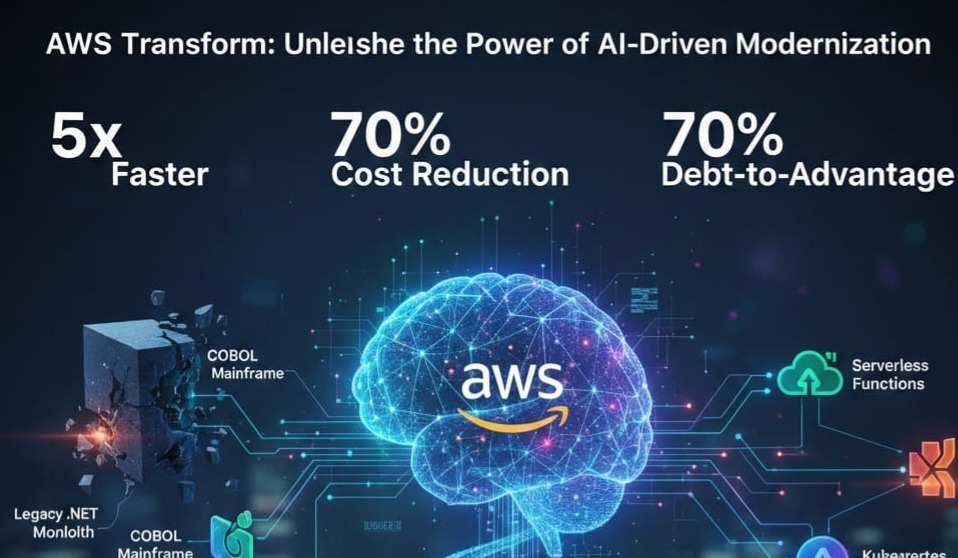
AWS Transform- When Legacy Becomes a Liability: The New Era of Cloud-Driven Transformation
Why Are Enterprises Still Trapped in Legacy—When the Cloud Is Waiting?
It’s Monday morning.
A bank’s critical application fails during peak hours.
Not because demand was too high.
Not because the cloud couldn’t scale.
It failed because a 20-year-old system—written in a language only a few people still understand—couldn’t keep up. The original developers retired a decade ago. The code is a black box of legacy .NET, COBOL, and aging frameworks, and every attempt to modernize it has been quoted as a three-year, high-risk gamble.
But what if you could compress those three years of manual drudgery into three weeks of AI-driven precision?
This is no longer a “what if.”
This is the era of AWS Transform.
AWS Transform is a managed AWS service that uses agentic AI — AI that can take action autonomously across tasks to modernize and migrate legacy applications, infrastructure, and codebases into AWS-ready, cloud-native formats. It’s designed to streamline and automate the heavy lifting of full-stack modernization.
Modernization is no longer just a technology upgrade.
It’s a business survival decision.
AWS Transform isn’t a simple script or a migration tool. It is a suite of specialized AI agents powered by Amazon Bedrock. These agents act as digital engineers—able to read legacy code, reason through complex dependencies, and rewrite entire applications to be cloud-native.
At the heart of AWS Transform are AI agents—autonomous units trained to perform complex modernization tasks end-to-end, including:
- Discovering and assessing legacy workloads: Understand application architecture, dependencies, and readiness for migration
- Code and framework transformation: Convert legacy languages or frameworks into modern alternatives
- Dependency extraction and mapping: Automatically detect and map libraries, APIs, and constraints
- Planning and validation: Generate transformation plans, estimate risks, and validate outcomes
- Execution at scale: Applying transformations in parallel across multiple applications.
In other words, the role of AI has shifted from:
“AI as a consultant”
to
“AI as a modernization workforce.”
AWS Transform uses Knowledge Items (KIs) and generative AI agents to do what was once considered impossible.
It doesn’t just lift and shift.
It refactors.
AWS Transform enables multiple modernization paths, including:
- Windows & .NET Modernization: Move .NET applications and Windows stacks to cloud-ready environments, including cross-platform .NET or AWS-native services.
- Mainframe Modernization: Analyze and transform large mainframe codebases, which traditionally take years to migrate.
- VMware Workloads to EC2: Shift VMware virtual machines to AWS EC2 with optimized configurations and network setups.
- Custom Code Transformation: Modernize bespoke codebases, including Java, Python, Node.js, internal frameworks, and domain-specific languages.
The impact of AWS Transform is felt on both sides of the organization:
Technical Impact:
- Up to 5× faster modernization for Windows workloads compared to traditional methods
- Projects that once took years can now be completed in months
- Automatic unit test generation for every change
- Built-in adherence to modern security best practices
Business Impact:
- Reduced legacy licensing and infrastructure costs
- Improved reliability, traceability, and documentation of transformation decisions
- Organizations report up to 70% reduction in modernization costs
These are not incremental gains—they are massive reductions in cost, time, and manpower for critical modernization initiatives.
AWS Transform delivers value across the C-suite:
- CEOs: Faster execution of digital strategy
- CIOs / CTOs: Scalable modernization without burning teams
- CFOs: Reduced infrastructure and licensing costs
- COOs: More resilient, cloud-native operations
AWS Transform doesn’t just modernize systems—it unblocks leadership decisions.
AWS Transform is a strategic accelerator. By leveraging generative AI and automation, organizations fundamentally change how modernization is done:
- AI-driven: Reduces manual effort, automates repeatable tasks, and learns from experience.
- Scalable: Handle hundreds of applications simultaneously.
- Flexible: Supports multiple target architectures and languages.
- Cost-effective: Eliminates many of the time and licensing costs of legacies.
- Collaborative: Provides shared workspaces and interactive tools for teams
But the biggest shift AWS Transform brings is psychological.
From:
“We can’t modernize—it’s too complex.”
To:
“We’re modernizing continuously—without disruption.”
Legacy systems stop being anchors—and start becoming launchpads.
Modernization is no longer about rewriting code.
It’s about rewriting what’s possible.
Technology has already moved ahead—the only question is whether leadership has.
Post a comment