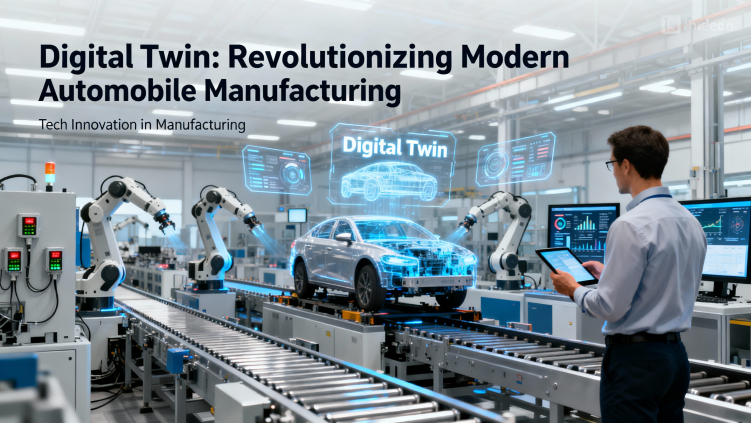
Digital Twin: The Strategic Backbone of Modern Manufacturing
It was 9 a.m. on a busy Monday morning when the assembly line at XYZ Motors came to a sudden halt. A critical motor in the packaging unit had overheated—again. The production line stopped, red warning lights flashed across the floor, and operators gathered to diagnose the issue. The maintenance team rushed between stations searching for the root cause. Deadlines slipped. Unplanned downtime had struck once more, and chaos erupted. The line was down for 10 hours, delaying a critical customer order.
Yet again, the team was reacting after the damage had already been done. The unplanned downtime had cost the company both money and goodwill.
But what if that machine failure could be predicted days, weeks, or even months in advance? What if teams could schedule maintenance before a breakdown occurred? What if they could test a solution or optimize a new process virtually before implementing it in the real world?
This is where the “Digital Twin” steps in...
A Digital Twin is a virtual replica of physical objects, processes, or even entire factories. Real-time data from IoT sensors continuously flows into the model, creating an exact digital counterpart that mirrors real-world performance. It bridges the physical and digital worlds.
This technology gives manufacturers a safe virtual test track to experiment, solve problems, and unlock new levels of efficiency—all without halting production or wasting resources. Manufacturers can predict equipment failures, test new layouts, and optimize entire production lines long before issues arise. A6 Digital Twin acts like a conscious system—monitoring health, predicting breakdowns, and simulating outcomes.
In manufacturing, digital twins can exist at three levels: product, process, and factory.
- Product Twin represents a digital version of a product, enabling virtual testing, simulation, and optimization throughout its lifecycle.
- Process Twin models manufacturing or operational processes to analyze workflows and identify improvements.
- Factory Twin is a comprehensive digital replica of an entire plant, including equipment, workflows, and environmental conditions, allowing full monitoring and control.
How a Digital Twin Works in Manufacturing
Consider a modern automobile manufacturing plant with hundreds of robots, conveyor belts, and specialized machinery. The process involves several key steps:
- Data Collection: IoT sensors embedded in critical equipment continuously monitor parameters such as vibration, temperature, motor current, pressure, and energy use.
- Digital Twin Creation: A digital replica of the entire production line is built and fed with real-time data to mimic its physical counterpart.
- AI-Based Analysis and Prediction: Artificial Intelligence and Machine Learning algorithms analyze incoming data, learn normal operational patterns, detect anomalies, and predict potential failures. Deviations from normal operations like minor vibration, frequency changes or temperature spikes, are flagged early to schedule maintenance before an actual failure occurs.
- Virtual Optimization and Decision Support: The digital twin simulates how predicted failures would affect the production line, identifies bottlenecks, and suggests optimal maintenance schedules. This enables planned downtime instead of costly unplanned halts.
Why It Matters to the C-Suite
For CXOs, Digital Twin technology is more than an engineering innovation—it’s a strategic imperative that drives measurable business value and competitive advantage.
- Reactive to Predictive Maintenance: It detects potential failures before they happen, drastically reducing unplanned downtime and maintenance costs—one of the biggest ROI drivers for executives.
- Accelerated Time-to-Market: Companies can iterate faster in the digital world, testing products and processes virtually to shorten development cycles and deliver innovation faster.
- Data-Driven Decision Making: CXOs can evaluate the impact of major investments before spending a single dollar. Real-time insights enable safer, smarter, and more informed decisions.
- Resource Efficiency: Digital twins enable virtual testing which prevent waste and support sustainability goals, boosting both profitability and environmental responsibility. Again, a major goal for executives.
In an era where unpredictability can cause massive operational risk, the Digital Twin offers CXOs a powerful lens to foresee challenges and shape smarter solutions.
It’s not just a tool—it’s becoming the new heartbeat of manufacturing innovation and resilience.
Now, let's come back to the same example with which we started after transformation occurred at XYZ Motors.
Three months after that chaotic Monday, XYZ Motors implemented a factory-level Digital Twin.
Now, the same critical motor in the packaging unit that once overheated silently sends performance data every second. Its twin monitors vibration, temperature, and load patterns—alerting the maintenance team 72 hours before a potential failure.
Instead of panic, the team schedules maintenance during planned downtime.
Instead of lost production, XYZ Motors consistently meets its targets and preserves customer trust.
Instead of chaos, there is clarity, stability, and control.
Digital Twin didn’t just repair a machine—it transformed operations from reactive to predictive.
“In a world where every second counts, Digital Twin turns uncertainty into confidence—and chaos into competitive advantage.”
Post a comment